Since the Trump Administration took office in its second term, there have been many policies and regulations aimed at tightening immigration. This time, on May 22nd, they gave a press release that focused on the Adjustment of Status(AOS) applications filed to get a green card, while in the US. This caused a lot of panic in the immigration community waiting for their Green cards.
As per the announced press release, they say that the adjustment of status will only be given for applicants who are in extraordinary circumstances. They released a policy memo that gives direction the immigration officers while adjudicating the AOS applications.
In this article, we will look at the actual press release, policy memo and give you all details regarding the changes, who it impacts, how it will work and the timelines, including next steps.
Background: What is Adjustment of Status(AOS)? How much Impact?
Below is a brief background of the Adjustment of Status and impact:
- The Adjustment of Status (AOS) is the process of applying for a US Green Card from inside the United States using the Form I-485. This is a standard process to get Green Card, when you are within the US.
- AOS is authorized under Section 245 of the Immigration and Nationality Act (INA). The alternative is consular processing, where you apply at a US Embassy or Consulate outside the US using Form DS-260.
- When you file for adjustment of status using the I-485, you can also file Form I-765 for Employment Authorization (EAD) and Form I-131 for Advance Parole (AP) at the same time. The AOS is filed only after your I-140 petition is approved, and your priority date becomes current per the Visa Bulletin
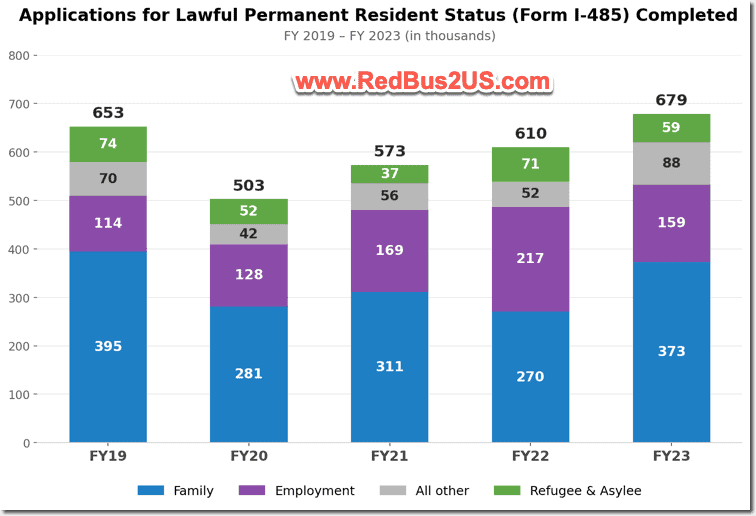
Adjustment of Status is one of the most common ways to get a green card, and USCIS, on average, processes about 600 to 700K per year. The graph below from USCIS FY 2023 annual report outlines the kind of impact this policy will have and how many people the new policy can impact:
Now that we understand the background and the kind of impact it can have, let’s now look at the actual policy memo and summary of the same.
If you prefer a video summary of this article, you can watch it on our YouTube channel: RedBus2US YouTube — USCIS AOS Memo Explained.
Everything about the new USCIS New Adjustment of Status Policy Memo:
Below are some of the key points, guidance, and our analysis on how USCIS will apply the new policy memo for adjustment of status applications:
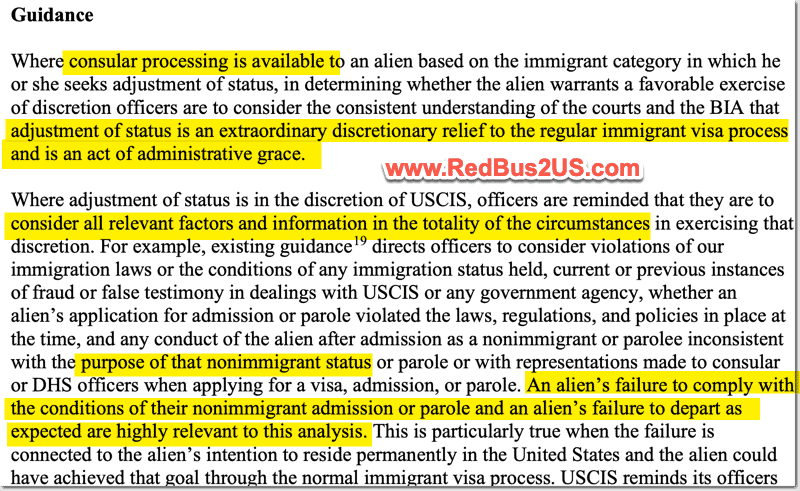
Adjustment of Status is an Extraordinary Discretionary Relief when Consular Processing is available
When Consular processing is available to an applicant seeking a green card, they must use that path, as it is the standard process. If an applicant applies for adjustment of status, then it will be subject to the discretion of USCIS.
As part of the discretionary evaluation, USCIS will look at all the factors of the case and history, including their status, family ties, etc. They will look at the applicant’s purpose of the non-immigrant visa and what they committed to when getting the visa.
Example: When someone applies for a non-immigrant visa, such as an F1 student visa or a B1/B2 visitor visa, as per the purpose of the visa, they must leave the US after their course of study or after the tourism activity. If someone did not leave, they must provide factors on why they did not leave and have a lot of positive discretionary factors outweighing the same.
Below is the screenshot of the guidance given on the policy memo that tells on how applicants should use consular processing and what would be looked at for adjustment of status applications:
What is Administrative Grace, Discretion? Sample RFE I-485
In the context of immigration application decision, the USCIS officer discretion means, it is essentially up to the USCIS officer reviewing your case. For example, if a person has a DUI on their record, the officer may say, “You had a DUI, so based on my discretion, I don’t think you should get a Green Card” — even if technically you meet every eligibility requirement. That is what “discretion” or “administrative grace” means.
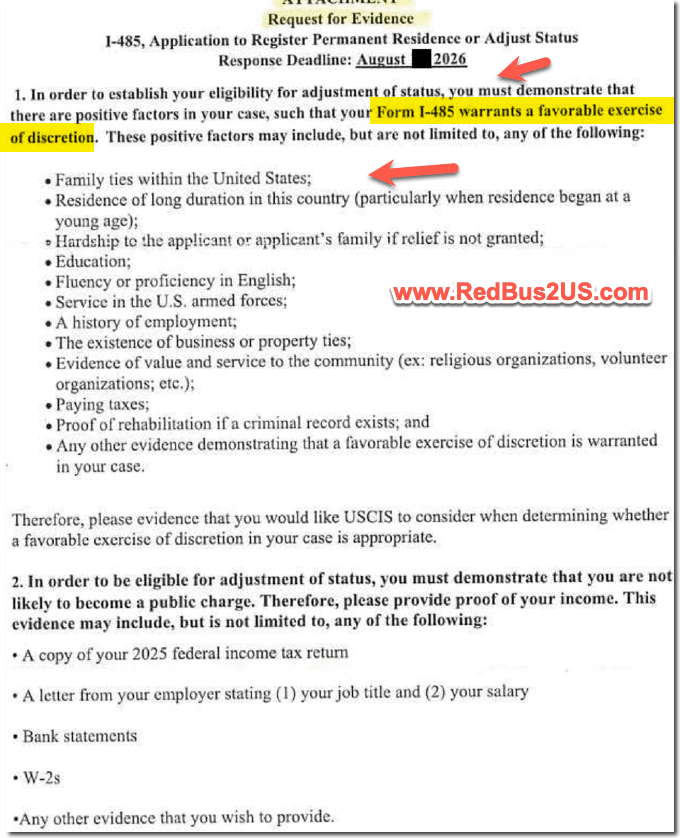
If the USCIS officer believes that you do not meet the requirements, they can issue an RFE asking for more information such as listed below:
- Family ties in the US
- Employment history
- Evidence of contribution to the community
- Bank Statements
- Tax Documents
- Many more
Below is an RFE (Request for Evidence) document that was issued for an Adjustment of Status application by USCIS recently( before the current policy memo) related to discretion and to show positive factors. It has a list of positive factors that they typically ask. Now, with the new policy memo, we can expect to see more of these.
Messaging: Press Release vs Actual Policy Memo
The press release from USCIS contains some alarming language, with USCIS Spokesman Zach Kahler saying that foreign nationals temporarily in the US who want a Green Card should generally return to their home country to apply. Below is the screenshot of the actual message, where it outlines the same.
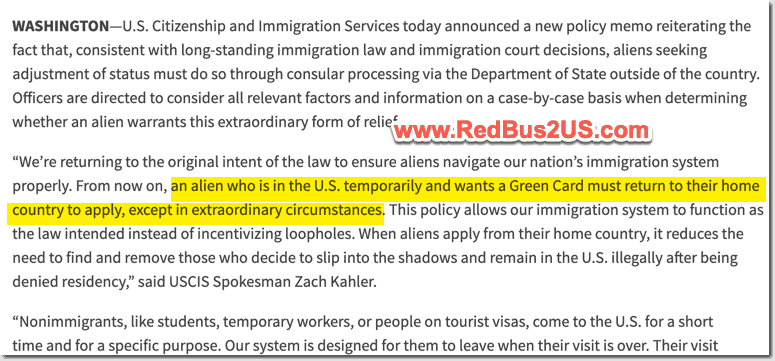
But, when you read the actual policy memo, it does not say that you must leave the country or anything as such. It is just the legal standard for the AOS cases is more discretionary. The memo still confirms that AOS remains a legal pathway authorized by Congress and that officers must do a case-by-case totality-of-circumstances review based on their discretion. The messaging in the press release framing is more political than legal. You can check the screenshot in the first section for more on the same.
In short the Immigration Nationality Act(INA) Section 245 itself did NOT change. Only the discretionary analysis is being tightened and applicants have to show more positive factors and in some cases, can be tricky for non-dual intent visas such as F1, B1/B2.
- Consular Processing Now Default: USCIS officers are told to treat consular processing as the “ordinary” route.
- Already-Approved Cases Safe: If your I-485 was already approved before May 21, 2026, this memo does NOT affect you.
Change of Status (COS) Not Impacted, Only Adjustment of Status (AOS)
COS and AOS are completely different processes. COS is done when you move from one visa type to other like F1 to H1B or H4 to H1B Visa. AOS is done to get a green card, when you are in the US.
The Change of Status (COS) process is not impacted. You can continue to get COS done using Form I-539. You can change between nonimmigrant visa categories, like F-1 to H1B or H-4 to H1B.
The new policy memo applies only to AOS (Form I-485), which is the final Green Card step. F-1 to H1B COS, H-4 to H1B COS, B-1/B-2 to F-1 extensions — all of these continue to work as before.
| Process | Form / Statute | Impact of New Policy memo PM-602-0199 |
| Change of Status (COS) | Form I-539 / INA 248 | NOT IMPACTED |
| Adjustment of Status (AOS) | Form I-485 / INA 245 | MORE SCRUTINY |
| Consular Processing | Form DS-260 / Dept. of State | Now the “Default” Route |
If you prefer a video summary of this article, you can watch it on our YouTube channel: RedBus2US YouTube — USCIS AOS Memo Explained.
What is the Legal Basis — List of Cases USCIS Cited in the Memo
The memo is not pulled out of thin air. USCIS in their policy memo talks about a chain of court and BIA (Board of Immigration Appeals) decisions stretching back over 50 years. The most important cases cited in the memo are:
- Matter of Blas, 15 I&N Dec. 626 (BIA 1974) — The foundational case. Established that AOS “was not designed to supersede the regular consular visa-issuing process” and introduced the “unusual or even outstanding equities” standard.
- Matter of Arai, 13 I&N Dec. 494 (BIA 1970) — Discretion weighs favorable factors (family ties, hardship, long residence) against adverse factors.
- Elkins v. Moreno, 435 U.S. 647 (1978) — US Supreme Court ruling that AOS is administrative grace, not an entitlement.
- Matter of Tanahan, Interim Dec. #2928 (1981) — Reinforced that AOS is not designed to supersede consular processing.
- Patel v. Garland, 596 U.S. 328 (2022) — The most recent Supreme Court ruling. Federal courts lack jurisdiction to review discretionary AOS denials.
Who are the most impacted? Dual Intent vs Non-Dual Intent
The biggest factor for who is impacted is whether your current visa is dual intent or non-dual intent.
Dual Intent Visas have Lower Risk
- H1B and L1 visa holders have statutory dual intent. Congress specifically allowed them to pursue a Green Card while in the US. They have the strongest legal position under this memo. They can have the intent to get a Green Card when they enter the US.
- However, the memo warns that maintenance of dual intent status alone is NOT sufficient to guarantee a favorable exercise of discretion. The applicants may need to provide more documentation for the same.
- We need to see how the new policy memo will play out as the policy does not give the nuts and bolts of how they will really apply the memo for H1B or L1 visa holders.
Non-Dual Intent Visa holder have Higher Risk
- We believe non-dual intent visas, such as B1/B2, F1/ OPT students, others who file I-485 may face the highest scrutiny and risk as they are supposed to leave after end of their visa and they should not have an intent to stay back to get Green Card in the US.
- Other visa types that may have higher risk are:
- J-1 exchange visitors (many also subject to 2-year home country residency rule).
- TN (Canadian/Mexican professionals), E-3 (Australians), O-1 (extraordinary ability).
- B-1/B-2 tourists — the memo’s “loophole” language directly targets visitor visa misuse.
Here is why this matters: if you are on an H1B (dual intent), an officer looking at your case can see your intent to settle was always allowed by Congress. But if you are on F-1, the officer can ask: “You came here to study and were supposed to leave. Why didn’t you go back?” That is the discretionary gap that needs to be filled with positive equities.
This is also true for marriage-based Green Card applicants who entered on a tourist visa — the memo’s “loophole” language directly targets this scenario, and even legitimate marriage-based cases will likely face heightened review and interviews.
Effective Date? What About Pending I-485 Cases? EAD?
As per the press release and memo, the policy memo is effective immediately from May 21st, 2026. As this is not a federal rule-making kind of thing, there is no feedback option for the public.
The memo does not specify how it applies to cases already pending. However, because the discretion analysis is done at the time of final adjudication, we believe that the new standard will likely apply to every I-485 not yet approved — regardless of when it was filed.
If you have a pending I-485, prepare a “discretionary packet” documenting positive equities. If your I-485 is denied at discretion, your EAD and Advance Parole would also end.
Will there be any Lawsuits on this new policy?
We expect to see many lawsuits filed against this new Policy memo in the coming weeks. There is also a very practical capacity issue at Consulates: we are talking about a few hundred thousand AOS applicants every year.
The US Consulates are already backlogged with pending cases worldwide. Pushing over half a million applicants out of the AOS pipeline and into consular processing simply is not something the consular system has the capacity to handle. This is one of the strongest practical arguments for litigation against the memo.
There is also a historical precedent worth remembering. During the first Trump administration, the Public Charge Rule caused similar panic in the immigration community. Lots of forms and additional paperwork were introduced, but in the end, most employment-based applicants were not significantly impacted, and the rule was eventually rolled back. We may see a similar pattern here — though no one can predict it with certainty. Either way, do not make hasty decisions based on the press release alone.
Next Steps? What Should You Do Now?
- Don’t Panic. When you panic, you make bad decisions. AOS is not gone — the new policy memo only signals more scrutiny on your application.
- Consult an Immigration Attorney. Get case-specific advice before any filing decision. If your current attorney is not responsive, consider getting a second opinion from a third-party immigration attorney.
- Consider Waiting If You Can. If your priority date is current, you can either file now with a discretionary packet, or wait until the dust settles and more guidance is issued. Discuss with your attorney which path fits your case.
- Maintain Lawful Status. No overstays. No unauthorized work. No status violations. Avoid international travel until things become clearer.
- Build a Discretionary Packet. Document your family ties, tax filings, employment history, community involvement, and clean record.
- Switch to Dual Intent, if Possible. If you are on a non-dual intent visa (TN, E-3, O-1, F-1), explore moving to H1B status before filing I-485.
- Continue PERM and I-140 Filings. These earlier stages of the Green Card process for Employment based Green Cards are not affected by the memo.
- Watch for Litigation Updates. Lawsuits are likely. Courts may pause or modify the memo. We will keep you posted.
What do you think of the new policy memo on AOS? Do you think it will be halted by the lawsuits? Does it impact you? Ask your questions, post your opinion in comments section below.
References: USCIS Policy Memo AOS Changes , USCIS Official Policy Document on AOS
