There have been rumors that the Trump administration would charge $100K for F1 OPT students, which was reported by Wall Street Journal, back in July 2026. Today, DHS published a proposed rule in the Federal Register that pretty much adds up to $100K fee for OPT, if you use OPT and STEM OPT.
In this article, we will look at the background of OPT, why DHS is planning to impose a fee for F1 visa OPT holders, how the current proposed regulation would work, what to expect in terms of lawsuits, how the past F1 OPT lawsuits worked and complete details on what to expect next.
Background: F1 Visa OPT, How many Students on OPT
Below is a brief background on F1 Visa OPT and details of how many international students on F1 Visa use OPT:
What is F1 Visa Optional Practical Training(OPT)
- International Students on an F1 visa can get a temporary work permit (EAD Card) to work in a job that is related to their field of study, which is called Optional Practical Training(OPT)
- OPT is usually given for up to 12 months for each degree level, like a Bachelor’s, Master’s, or PhD. But, if you graduate with a STEM degree, you can get an additional 24 months of extension of OPT called as STEM OPT.
- Students can use OPT during their studies or after their studies. If you use during studies, it is called pre-completion OPT, if you use it after graduation, it is called post-completion OPT.
- Currently F1 Students pay $470 or $520 OPT application fee to USCIS for their OPT EAD card. No additional fee is charged to the School by DHS as of today.
How many Students are on OPT in the US?
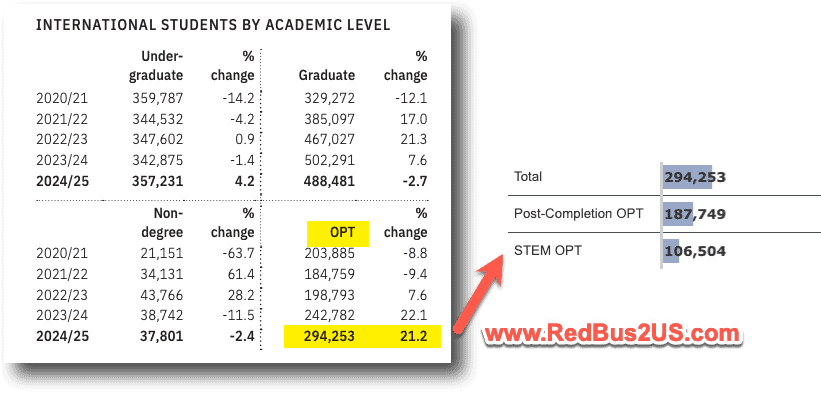
- As per the IIE OpenDoors Report, there are about 294,253 students on OPT in the US in total, of which 106,504 are on STEM OPT and 187,749 students are on regular OPT.
- The number of students using the OPT program went up by 21.2% in the year 2024-2025.
- If the proposed regulation becomes final, it will affect nearly 294K students.
- Below is a screenshot of the actual OPT usage data and trend from the OpenDoors report.
📺 You can watch YouTube video of this article at F1 Visa $70K Fee for OPT – Analysis
Why is DHS planning this F-1 OPT Fee Regulation?
DHS says that the main goal of creating this regulation is to stop fraud in the OPT program and protect US Workers. Below are some of the key reasons mentioned in the regulation:
- In a 2020 case, fake job letters were sold to about 2,693 Students. As per their analysis, they say about 10,000 Students on OPT work for “highly suspect” employers.
- DHS says that over 4000 students used shell companies for fake employment records related to OPT
- OPT workers are cheap to hire for companies as they are exempt from Social Security and Medicare taxes and it saves about 7.65% for employers.
- There is no cap on the OPT program and employers are using it to avoid the H1B limits and wage rules to hire cheap workers that impact Americans looking for jobs.
DHS Proposed Regulation Summary: $70K for F1 OPT
Below is the summary of the proposed regulation and how it works :
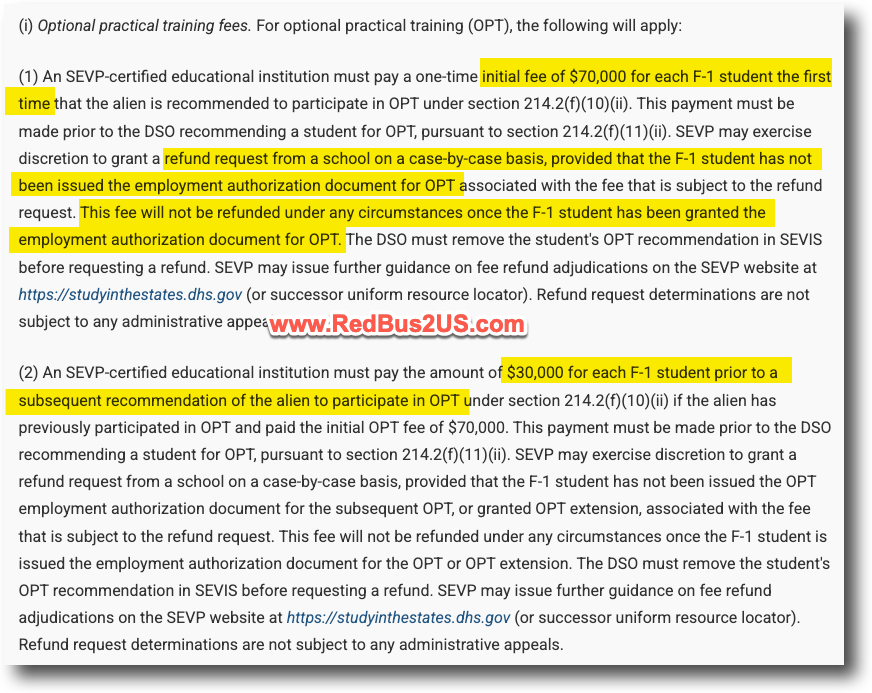
- $70K Initial OPT Fee: The University recommending OPT for a student must pay an initial fee of $70,000 for each F1 student for DHS to approve the initial OPT. This fee has to be paid to DHS before recommending the OPT for the student.
- $30K Subsequent OPT Fee: For subsequent OPT extension requests such as STEM OPT, the University/School has to pay an additional $30,000 for such requests.
- Pre-completion OPT Cases: If the student used pre-competion OPT, then the school should pay $70K for the pre-completion OPT, $30K for the post-completion OPT, and if student want to use STEM OPT extension, that would be another $30K. In total the student would pay $130K in this case, if they used all the three OPT options.
- OPT Fee Refunds: Refunds maybe be given on a case-by-case basis based on DHS’s discretion, in cases, where the EAD card was not issued for the student. If the EAD card related to OPT was issued, they will not give any refunds.
- Universities have to Pay, can pass on to Students: As per the regulation text, Universities have to pay the $70K or $30K fee for recommending the OPT for their students. They can pass on the fee to students and collect the same from students.
Below is the screenshot of the regulatory text that is related to the above:
Who are impacted with F1 OPT Fee Regualtion?
- All F1 Visa students whose OPT recommendation from School is dated on or after the effective date of the final rule. As of today, the rule is not final.
- The Students whose OPT recommendation is before the effective date of the regulation are not impacted.
- Curricular Practical Training(CPT) students are not impacted with the regulation.
- On Campus jobs are not impacted with this additional fee.
- All future F1 students, who plan to work on OPT after the effective date of the final rule will be impacted.
- About 2,478 schools that recommended OPT during 2022-2024 are likely to be impacted by this regulation if it becomes final.
Now that we have looked at the regulation on how it would work, let’s now analyse the OPT program creation, past lawsuits, new lawsuit options
OPT was not created by the US Congress
The OPT program was created by a Federal Agency that handled US Immigration. It was not created by US Congress. Below is a brief history of the OPT Program:
- The US Congress created the Student Visa as part of the Immigration Act in 1924.
- In 1947, the Immigration and Naturalization Service(INS) Agency creatd a regulation that allowed practical training for students for up 6 months with extension options
- In 1992, the official Optional Practical Training was created
- In 2008, DHS added the 17 month STEM Extension
- In 2016, DHS extended the STEM to 24 months from 17 months.
There was a 9-year court fight to end OPT program as part of the WashTech vs. DHS lawsuit. Below is the brief history:
- In 2014, Tech Worker Union, aka WashTech, sued the 2008 STEM Extension by DHS
- In 2015-2016, Courts said that DHS skipped public comment, so DHS re-issued it as a 24-month STEM Extension OPT based on proper regulatory process
- In 2016, another lawsuit was filed targetting all of the OPT prgoram.
- In November 2020, District court sided with DHS
- In October 2022, Appeals court uploads OPT and STEM OPT
- In October 2023, Supreme court declines to hear the case and the challenge ends.
In short, the courts ruled that DHS has the authority to create OPT and also modify as they needed. This is something important that gives DHS power to do regulations to change it.
Future Lawsuits, What to expect ?
- As far as the OPT itself, based on the WashTech vs. DHS, it is clear that DHS has the authority to do so.
- Now, coming to the $70K fee, this is where it can be tricky as courts have ruled in the past H1B $100K fee lawsuit that DHS cannot collect a fee from applicants as it will technically considered a Tax and there is no clear justification to collect it as a fee.
- Also, DHS is now fighthing another lawsuit related to the ending “D/S” with a fixed time period.
- Unlike $100K fee proclamation, in the current case, there is a regulation and comment period as well. So, we need to see, how it will be treated.
- Looking at the past situations, it is highly likely that there will be a lawsuit, if DHS is planning for such heavy fee for OPT. We may not see anything until the rule becomes final.
Next Steps
- DHS has given 60 days to submit comments. The comment period ends on December 7th, 2026
- After the comment period, DHS would review the comments and final rule would be published.
- Usually, they would give 60 days after the final rule to take effect.
- We can expect lawsuit after the final rule is published.
What do you think of the proposed regulation? Share your thoughts in comments section below.
References: Official Regulation on Regulations.Gov Website, DHS Press Release on OPT New Fee
