The PERM Program by the US Department of Labor(DOL) has been under a lot of scrutiny since the Trump administration took office in its second term. They suspended the PERM program for 8 big companies like Microsoft, Adobe, TCS, and others based on an investigation.
Today, they published a proposed rule in the US Federal Register, outlining the changes they plan to make to the PERM Program, which is required for many employment-based green card applicants. It is a massive 350-page document and is set to make big changes to the PERM program. The previous major PERM program rules were set in March 2005, over 20 years ago.
In this article, we will look at the background, review a summary of the key changes to the PERM program in the proposed rule, explain why the US DOL is doing it, what kind of impact it can have on the program, compare the current and proposed changes, and discuss next steps on this regulation.
Background: PERM Program, Why is the DOL Planning Changes?
Below is the brief background of the Green Card PERM Program and why the US Department of Labor(DOL) is proposing the changes to it.
PERM Program in the Green Card Process
- PERM stands for “Permanent Labor Certification.” It is the first step for most employment-based green card applications, such as EB-2 and EB-3. As part of this process, the employer has to prove that no qualified American worker is available for a particular job.
- To file a green card application with USCIS, which is an I-140 petition, for most EB-2 and EB-3 applications, employers need to get a certified PERM from the US Department of Labor.
- PERM Key Steps : As part of the PERM process, employers have to get the prevailing wage for the job, do recruitment, and then finally submit the PERM application using Form ETA-9089. The regulation proposed by DOL changes all three aspects of PERM certification.
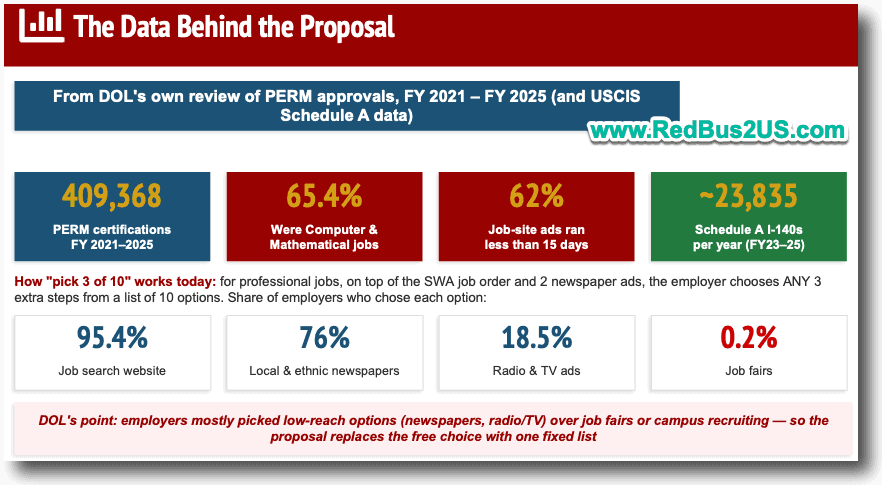
- PERM Process: Today, as per the current process, for recruitment related to PERM, the job order has to be at the state Workforce Agency(SWA) for 30 days; there need to be two Sunday print newspaper ads; for professional jobs, employers can pick 3 steps from a menu of 10 options for advertising/recruitment ads. Also, the recruitment needs to be done within 30 to 180 days before filing.
- PERM Rules: As per the current process, the recruitment report is held with the employer and sent to DOL only if there is an audit. The layoff check at the company looks at only the past 6 months. As per Schedule A provisions, nurses, physical therapists, and Group II applicants can skip recruitment. An approved PERM is valid for 180 days to file for the I-140.
Why is the US DOL changing the PERM Program Rules?
- The US DOL says newspapers are an outdated way of hiring; many newspapers are closing, and audits show very few people apply through print ads.
- Many US workers see the PERM-style ads and think the job is not open, as it is a PERM program ad. They also say the US applicants’ hiring process is not standardized, and they are screened differently.
- DOL says that many tech companies do layoffs of US workers, but continue to sponsor H1B and PERM cases. Based on recent enforcement actions at Cloudera, Cognizant, and other companies, they want to fix the loopholes of the program and make it fair for US workers.
Below is a snapshot of the data from the proposed rule that outlines the usage of the PERM program and usage of various recruitment channels.
Summary of the Proposed Changes to the PERM Program
The Official Proposed Regulation Name is “Modernizing the Labor Market Test and Improving Protections for U.S. Workers in the PERM Immigrant Visa Program“. It is a 350-page document that plans to rewrite the PERM regulations at 20 CFR Part 656.
For the sake of simplicity, we will divide the key changes to the PERM program into sections and cover relevant changes under each of those in detail. Let’s look one by one:
New Mandatory Recruitment Methods
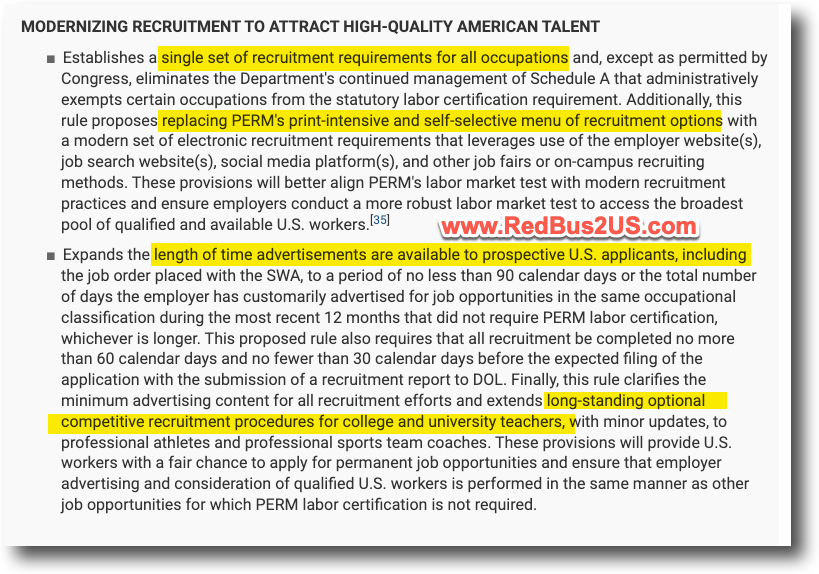
In the past, employers could choose from 10 menu options, and there were two Sunday Newspaper ads. Now, in the proposed rule, they are all gone, and the DOL mandates the recruitment methods listed below:
- State Workforce Agency Job Order: 90 days
- Employer Website Career page that is used for normal job postings: 90 days
- Job Search outlets that are normally used – at least one outside job board: 90 days
- Job Faris or Campus recruiting – at least one of them during the SWA posting period.
- If Social Media is used for recruiting today, they must be used as well for PERM jobs.
Also, DOL is asking for public feedback on whether they should also require employers to ask their current employees about PERM jobs and ask them for referrals of qualified US workers, similar to H2B.
Below is the screenshot of the actual regulatory text on the Federal Register
Run Job Ads Longer, Submit Full Recruitment Report
In the proposed rule, DOL is planning to increase the duration of how long the PERM-related job ads run and submit a full recruitment report upfront. Below is what they are proposing:
- All the job ads, including the SWA job order, should run for at least 90 days. If the employer typically posts for longer periods than 90 days, they should continue to post in a similar fashion.
- The recruitment has to end anywhere from 30 to 60 days before the filing. Currently, it can run up to 180 days before.
- All the job posting ads should state the wage or wage range, location, whether it is remote or in-person, overtime, and the number of openings. An ad can cover multiple jobs if it meets all the requirements listed above.
- Employers have to submit a full recruitment report upfront with the application. In the past it used to be only during audits. Below is the info they need to submit:
- List all the US applicants, their contact info, resume, and how they applied
- Show details on whether they met the minimum requirements, whether any offer was made, and the lawful reason for each rejection.
- Show the details of the names of those who were screened or interviewed. Also, DOL needs to be updated if layoffs happen later.
Recruitment has to be like any Other Job
As part of the proposed rule, the company has to act in good faith and needs to use the same channels, same process, and same terms as the company’s non-PERM jobs. Below are some of the things that employers ned to follow and what is not allowed:
- Employers must use the same careers page and the same application system for hiring PERM workers as for others. Cannot use PERM-only email addresses, Fax or special PERM hiring job listing pages.
- The Job interviews have to be done by phone or video and run by a US worker who normally does the interviews.
- Job requirements for PERM-related jobs cannot be tougher than the regular non-PERM jobs. They cannot be tailored to fit the PERM-sponsored worker’s resume.
- Every channel that is used for job applications should be open and monitored like normal job recruitment.
- Employers cannot reject a qualified US worker because of the cost that is tied to salary or benefits. Also, employers cannot give sponsored workers easier interviews.
- If companies break these rules, they are considered to be acting in bad faith; PERM would be denied and referred to the Justice Department for further steps.
Schedule A is Eliminated – Need Full PERM Recruitment
As part of the proposed rule, the concept of “Schedule A,” DOL’s pre-approved shortage list since 1965, would be eliminated entirely. DOL says that its 2023 study got 2000+ comments, and it cannot prove the nationwide shortages based on that. They say that law does not allow exemptions. Below are the proposed changes and what it means:
- Group I workers, who are professional nurses & physical therapists, and Group II workers, who are persons with exceptional ability in the sciences, arts, or performing arts, do not receive any special recruitment exemption.
- Currently, there is no recruitment requirement for Group I and Group II workers. But under the proposed rule, all of these workers must go through the full PERM recruitment process and obtain DOL approval before submitting an application to USCIS.
No Layoffs in the past 2 years, Third-party Staffing
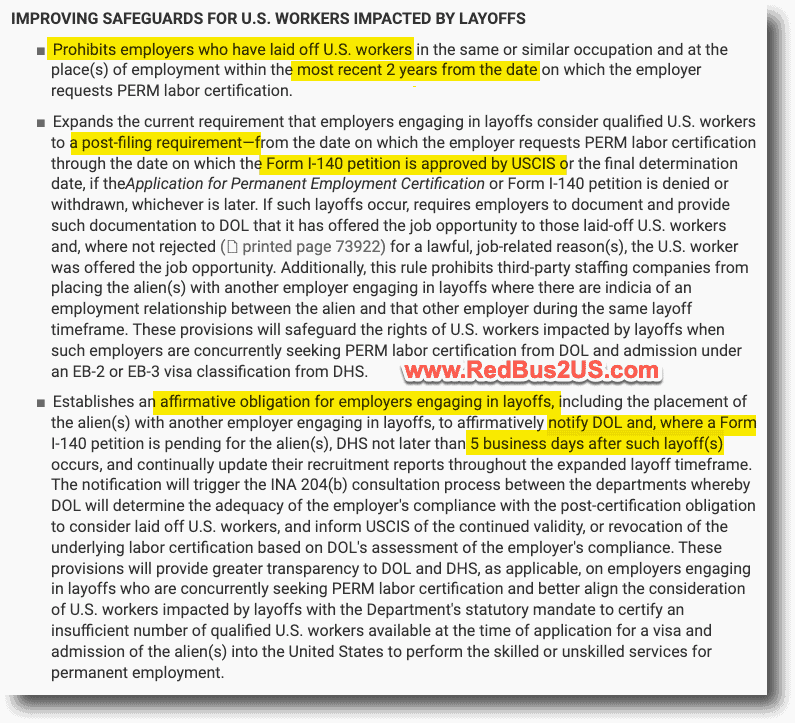
The layoffs lookback used to be 6 months; now, in the proposal, it is up to 2 years. Below are the changes related to Layoffs and third-party staffing:
- A company cannot file a PERM application if it laid off a US worker in the same or similar job in the same area in the past 2 years.
- If there is a layoff in a company after filing PERM, they need to be reported to the DOL within 5 business days. Also, inform USCIS if the I-140 is pending. The laid-off workers must be offered the PERM job first and hired unless they lawfully reject it.
- Staffing companies cannot place a worker at a client that had similar job layoffs in the same window. Basically, companies cannot replace American workers and put in third-party contract workers in the same place for the same job.
Below is the screenshot of the actual regulation text for the above from the Federal Register.
More Transparency – Notice of Filing, Enforcement
DOL proposes more transparency for US workers and also limits the use of PERM. Below is what they are proposing:
- The Notice of Filing has to be posted from 10 business days before the filing through the I-140 approval at the client or third-party worksites, including electronically
- One PERM can be used with one I-140 only. An approved PERM can support only the first I-140 filed with USCIS within 180 days. You cannot reuse it after an I-140 denial.
- The debarment scope is expanded to Attorneys and agents. If an attorney or agent is found to have done anything wrong, they can be debarred. The ban would cover all DOL foreign labor programs.
- Everything would be fully electronic. The prevailing wages and PERM filing would be done online with e-signatures, and DOL would send decisions directly to USCIS.
Below is a screenshot of the regulatory text from the proposed rule on the Federal Register:
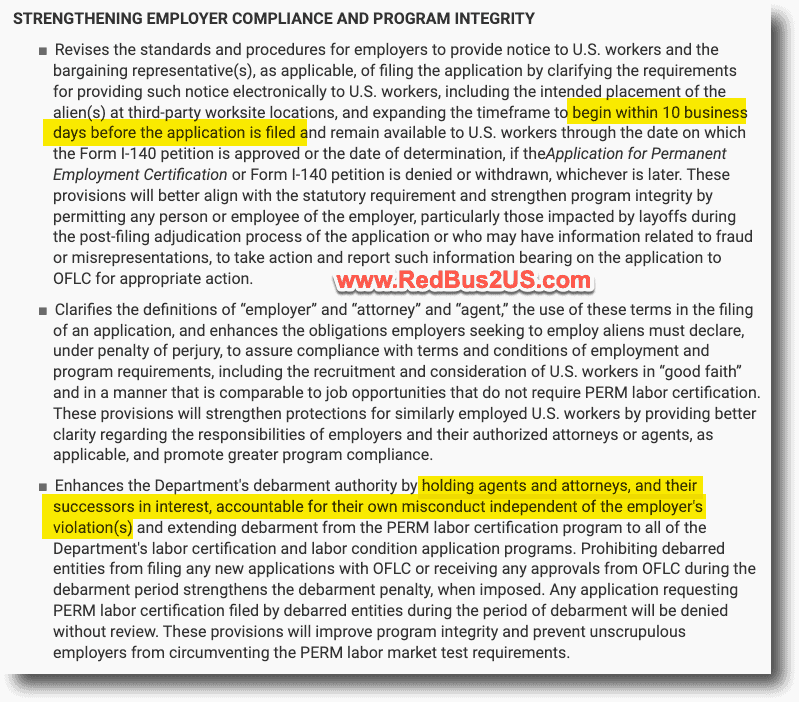
Remote Work and Roving Jobs Requirements
DOL is proposing rules for remote work and roving jobs. For the first time, the PERM program rules would state that a job is remote, hybrid or roving jobs (A roving job is something where you do not know the exact location at the time of filing and you could move between multiple clients as needed). Below is what is proposed :
- Remote job location would be listed as the worker’s city, county, and zip code(BLS area). Not a home address.
- The job ads and notice of filing should say the job is remote or hybrid and where the worker can live.
- If the job is remote, the notice of filing has to be posted electronically.
- For Roving jobs, each job would have its own location rules. The employer must choose the closest address in the area where the work would be done. For instance, if the employer has offices in Atlanta, GA, and Charlotte, NC, and the roving job would have the employee travel to all locations in Georgia, then the employer must list the Atlanta, GA office address.
Comparison of PERM’s Current Rule vs. Proposed Rule
Below is a side-by-side comparison of the changes:
| Topic | Current Rules | Proposed Rules |
| Newspaper ads | Two Sunday print ads are required | Removed |
| Other recruitment Options | For Professional jobs: 3 of 10 menu options to pick | Fixed list for all jobs: website, job board, social (if used), job fair/campus |
| Ad duration | SWA order 30 days; no minimum for other ads | 90+ days for all methods (or the employer’s normal length, whichever is longer ) |
| Recruitment timing | Within 30 to 180 days before filing | Must end 30 to 60 days before filing |
| Recruitment report | Kept on file; sent only if audited | Filed with every application, with all resumes, contact info |
| Layoff check | Consider prior 6 months | No layoffs in prior 2 years + until I-140 approval |
| Notice of Filing | 10 business days, 30 to 180 days pre-filing | From 10 business days before filing to I-140 approval |
| Schedule A | Nurses / Physical Therapists, Group II workers skip recruitment | Removed — full PERM required for all. |
| Reusing an approved PERM | Disputed after an I-140 denial | One PERM supports one I-140 only. Cannot reuse after denial. |
Who are impacted by the new proposed rules?
If the PERM is filed after the transition deadline as listed in final rule, it would impact the below:
- EB-2, EB-3 Perm Applicants who are in H1B, L1, F1, OPT, Other status
- Foreign Nurses and Physical therapists
- Workers in companies with recent layoffs, mostly Tech companies.
- Consultants placed at end-client locations by staffing companies.
- Remote workers
As per the proposed rule, during FY 21-25, about 65.4% of PERM approvals were for Tech Workers. So, the biggest group that would be impacted is computer and math jobs in the tech field.
Timelines, Next Steps
The proposed rule was part of the regulatory agenda; below is how the overall timeline looks
- July 2026: Regulation listed on DOL’s regulatory agenda
- September – October 2026: White House – OIRA Review
- November 17th, 2026: Proposed Rule Published in Federal Register
- Jan 16th, 2027: 60-day comment period ends
- March – May 2027: Estimated Final Rule; can be longer or earlier as well.
What do you think of the proposed rule to change the PERM program? Share your thoughts in the comments section below.
